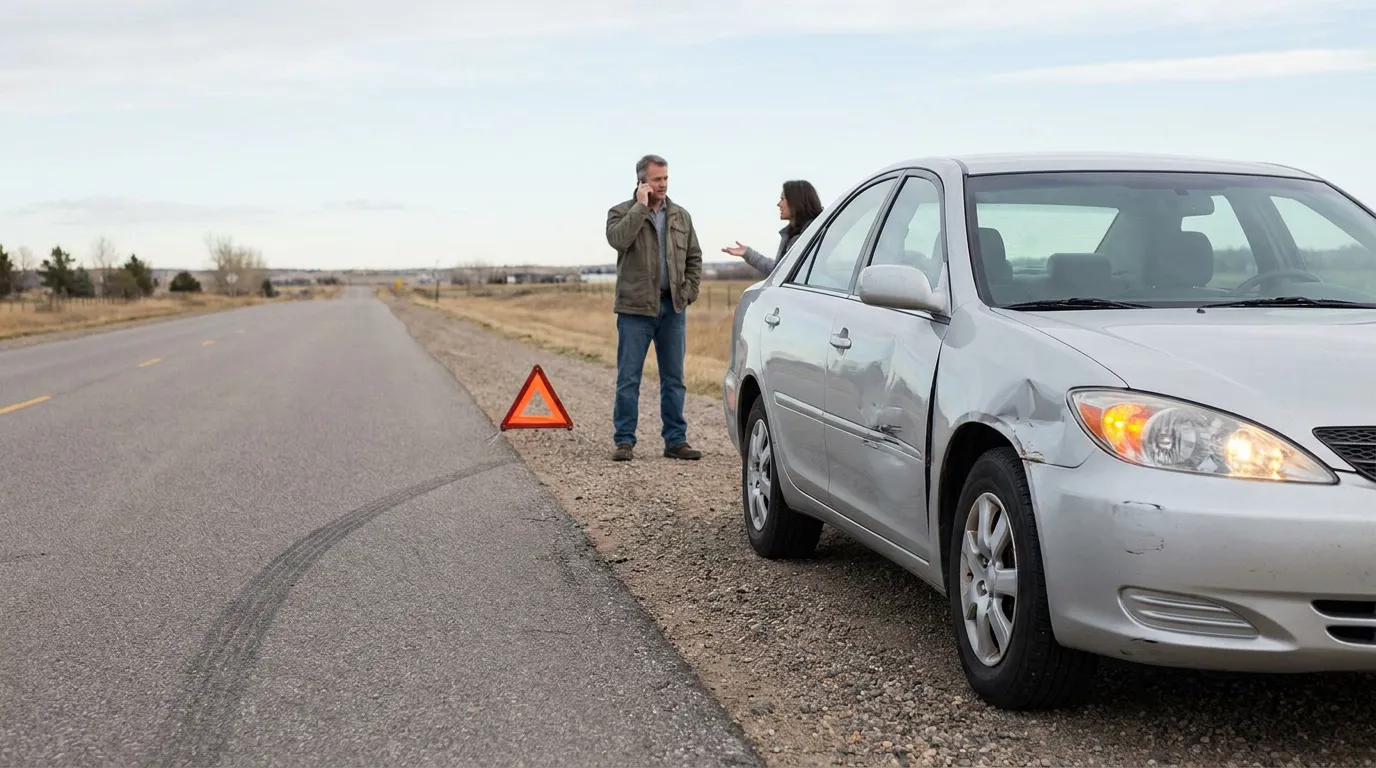
Yes. Colorado operates under a fault-based auto insurance system, meaning the driver who caused a collision is financially responsible for resulting injuries and property damage. The driver responsible for causing the accident is liable for damages, and that driver’s liability insurer generally pays the claim. That rule shapes nearly every step of fault-based car accident claims in Denver and across the state.
If you were hurt in a Centennial crash, this system gives you the right to pursue compensation directly from the at-fault driver or their insurer. Understanding how fault-based insurance works can significantly impact your claim approach, evidence gathering, and potential recovery.
At-Fault Versus No-Fault States
Colorado follows a fault-based system, not no-fault rules. This means you can pursue compensation directly from the at-fault party’s insurance without meeting specific injury thresholds. This system differs from no-fault states, where each driver’s own insurance pays regardless of who caused the crash.
However, if your accident occurred in a no-fault state, different rules apply. In a no-fault state, an injured driver usually turns first to the personal injury protection (PIP) part of their own policy for medical bills and lost income. Stepping outside that system to bring a claim against the other driver is often limited to more serious injuries. Each no-fault state imposes different rules regarding severity thresholds and the process of pursuing additional compensation beyond basic benefits.

Colorado’s Minimum Liability Coverage
When the insured driver causes a crash, liability coverage pays for the other person’s injuries and for damage to their car or other property.
Every Colorado driver must carry at least a minimum level of liability coverage. These minimums, often written as 25/50/15, represent the least amount of coverage a driver must maintain. In serious accidents involving significant medical bills or multiple injured parties, these minimums may fall short of covering your full losses.
If the at-fault driver carries only minimum coverage or no insurance at all, your own UM/UIM policy may be the only source of additional recovery. For your own policy, consider liability limits of at least $100,000/$300,000/$50,000, along with matching uninsured/underinsured motorist coverage.
Where Payment Comes From
Compensation usually comes through one of three routes:
- The other driver’s liability insurer, which is the first place most claims go.
- Your own coverage, when the other driver has too little insurance or none.
- A lawsuit against the at-fault driver, when the insurer will not pay what the claim is worth.
Beyond liability coverage, Colorado offers several additional coverage types that protect you after a crash. Knowing what your policy includes can determine whether you face out-of-pocket costs when the other driver is uninsured or underinsured.
Uninsured and underinsured motorist coverage deserves special attention. A meaningful share of drivers carry no insurance at all. If the driver at fault has no policy, or one too small for your losses, UM/UIM steps in to pay for your injuries. Colorado law includes this coverage by default unless you reject it in writing, so check your declarations page.
Medical payments coverage provides a no-fault safety net within Colorado’s fault-based system. This coverage pays up to $5,000 for reasonable health care expenses for you and passengers regardless of who caused the accident. It is included by default unless you opt out, providing valuable coverage while waiting for a liability claim to resolve.
A lawsuit has limits too. Many drivers carrying minimum coverage have limited assets, making collection challenging. Commercial vehicles are a different story: federal regulations require commercial trucking companies to carry substantially higher insurance minimums than regular vehicles, often $750,000 to $5 million depending on cargo type.
How Shared Fault Affects Your Recovery
Once fault is quantified, percentages directly reduce or eliminate compensation. Colorado’s shared-fault rule can shrink an award or block it entirely. Under C.R.S. § 13-21-111(1), your negligence doesn’t bar recovery as long as your fault was less than the defendant’s, but damages are reduced proportionally to your share of fault.
Recovery is barred when numbers reach a threshold. Under C.R.S. § 13-21-111(3), if your negligence proportion equals or exceeds the defendant’s, the court enters judgment for the defendant and you recover nothing. Colorado’s approach aligns with over 30 states using modified comparative negligence, a plaintiff-friendlier model than strict contributory negligence.
Fault converts into dollars straightforwardly once percentages are set. If a jury values your damages at a certain amount and assigns you blame, your award is reduced by that proportion. Under C.R.S. § 13-21-111(2)(b), special verdicts must state each party’s negligence degree as a percentage. Knowing Colorado’s modified comparative fault rule helps you anticipate how adjusters or juries might view your role.
Police reports, witness statements, vehicle damage, weather, and traffic-law compliance influence fault determination. Sudden stops, brake issues, or road hazards can shift blame to the lead driver or a third party. A Centennial driver who was speeding slightly when another motorist ran a red light did not necessarily forfeit the right to compensation.
Time Limits for Car Accident Claims
Colorado law imposes strict deadlines for filing car accident lawsuits, with the statute of limitations generally set at three years from the date of injury under C.R.S. § 13-80-101. This timeline applies to personal injury claims arising from car accidents in Centennial, giving you a limited window to pursue legal action. Missing this deadline typically results in permanent loss of your right to seek compensation through the courts.
Property damage claims follow different timelines that accident victims must track separately. While personal injury claims have a three-year limit, property damage claims may have different deadlines depending on the specific circumstances. Additionally, claims against government entities, such as accidents involving city vehicles or road defects, often require notice within 182 days, making immediate legal consultation critical. Colorado courts have consistently held that failure to provide timely notice is an absolute bar to the claim.
Various factors can affect these deadlines in complex ways that require careful legal analysis. Courts interpret deadline extensions and exceptions narrowly, meaning assumptions about tolling or discovery rules can be dangerous. Circumstances that may affect filing deadlines include:
- Minor victims who may have extended timeframes
- Injuries discovered after the accident date
- Defendants who leave Colorado after causing the crash
- Mental incapacitation preventing timely filing
- Fraudulent concealment of critical facts
Calendar your deadline immediately after any accident and seek legal consultation well before it approaches. Waiting until the last minute can compromise your case preparation and limit your options.
Steps to Take After a Crash
Steps you take immediately after an accident can shape your entire claim outcome. Colorado’s fault-based system rewards thorough documentation and quick action, including meeting the 60-day DMV deadline for reporting certain crashes. Consider these steps:
- Phone 911 and ask that officers write up a report, even after a minor crash
- Photograph vehicle damage, road conditions, traffic signals, skid marks, and visible injuries
- Swap insurance information with every driver involved, and ask witnesses how to reach them later
- See a doctor within 24 to 48 hours, even when you feel okay
- Keep the crash off your social media accounts
Request a copy of the police report and review it for accuracy, since errors can influence fault determinations later. Officers’ determinations about fault, while not binding on insurance companies or courts, can significantly influence early negotiations and claim evaluations.
Be careful with statements to the other driver’s insurer. Recorded statements sounding like apologies can push your fault percentage higher, directly shrinking potential recovery.
Getting Help Proving the Other Driver’s Fault
In an at-fault state, the injured person carries the burden of showing who caused the crash. To establish negligence, you must show duty, breach, causation, and damages.
A lawyer’s job on fault is to gather that proof and answer an insurer that argues you share the blame. An attorney can also retain accident reconstruction professionals for complex collisions. For clients of Jacobs Law, that work is done by Dan Jacobs, who has carried a Colorado law license since 2012 and handles every case himself.
Our page on proving fault after a Denver car accident explains how those claims are handled.
Talk With Jacobs Law
If you were hurt in a crash in Denver, Centennial or anywhere in the south metro, we can help. Contact Jacobs Law to schedule a free consultation and tell us what happened.