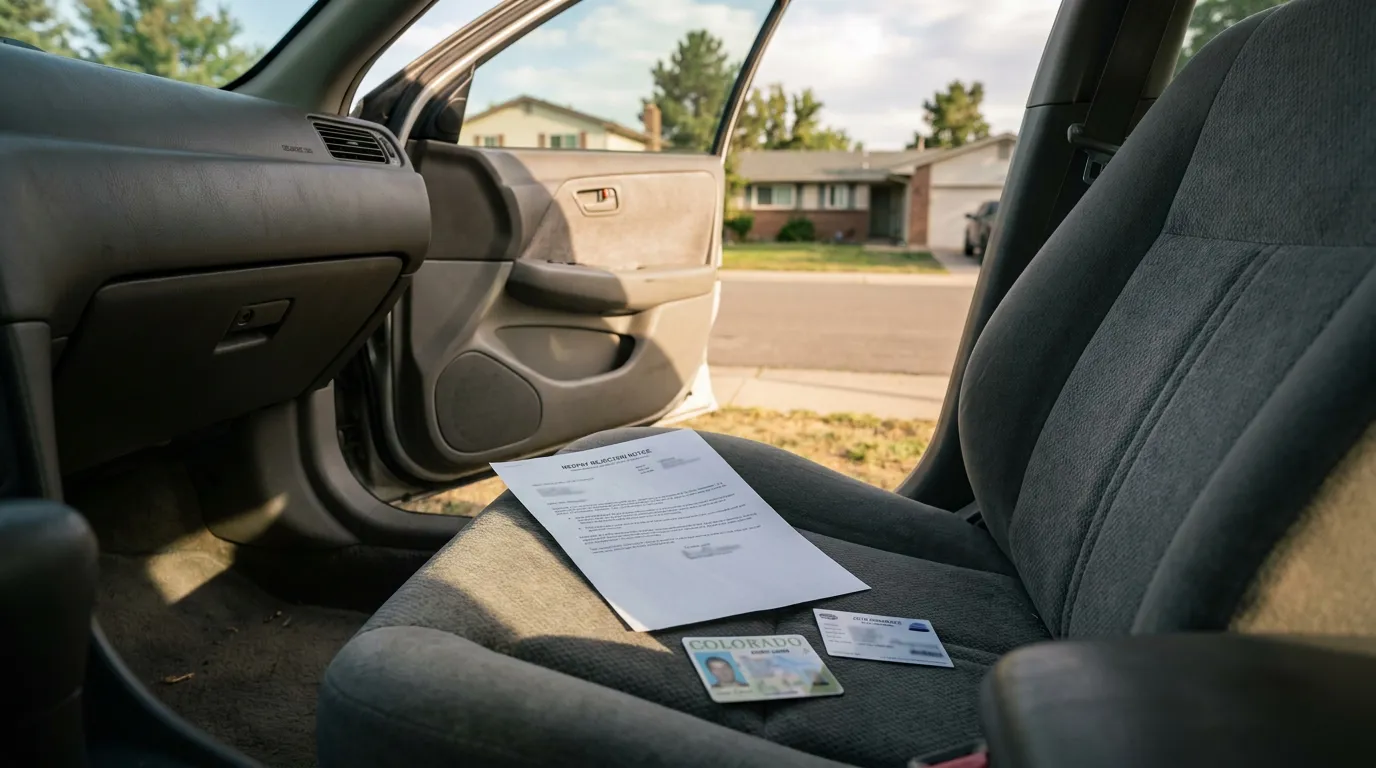
The One-Page Document That Can Quietly Erase $5,000 of Crash Coverage
Key Takeaways: A MedPay rejection form is a written or electronically recorded document proving a policyholder affirmatively declined the $5,000 in medical payments coverage that Colorado insurers must offer. The coverage is optional but the declination must be documented, so an insurer denying MedPay should generally produce a rejection consistent with how the policy was purchased, a signed form, recorded call, or electronic record. When MedPay is part of the policy, Colorado law directs insurers to reserve $5,000 for 30 days for emergency and trauma care providers, and state regulators explain that MedPay is generally paid before health insurance and may be applied to deductibles and coinsurance. Not every denial involves a rejection, since exclusions such as the workers’ compensation exclusion upheld in Del Valle v. California Casualty Indemnity Exchange may lawfully limit benefits, and MedPay need not be offered on motorcycles, low-power scooters, or off-road vehicles. Requesting the declarations page, rejection record, full policy, and parallel UM/UIM rejection is a practical way to test whether a denial holds up.
A MedPay rejection form is a short written (or electronically recorded) document showing that a policyholder affirmatively declined medical payments coverage on a Colorado auto policy. It matters because Colorado law treats MedPay as opt-out coverage: insurers must offer at least $5,000 in medical payments benefits, and that coverage is generally included unless the named insured opts out. When an adjuster denies your early medical bills after a Centennial crash, the first question is whether a valid rejection actually exists in the underwriting file.
If an insurer has denied MedPay benefits after your collision, Jacobs Law can review the policy and rejection documentation. Call 303-529-4040 or contact us now to discuss what coverage may still be available.

How Colorado Treats Medical Payments Coverage by Default
Colorado’s MedPay framework starts from an offer requirement, not a purchase requirement. For policies issued or renewed on or after January 1, 2009, insurers writing auto policies in the state must offer at least $5,000 in medical payments coverage, and the coverage is generally included unless the named insured affirmatively opts out.
The statutory basis sits in C.R.S. § 10-4-635. In Del Valle v. California Casualty Indemnity Exchange, 2022 COA 138, the Court of Appeals confirmed the plain language makes medical payments coverage optional at the insured’s discretion. Because the coverage is optional, insurers may accept a declination, but they generally must document it.
MedPay is a first-party benefit that does not depend on fault. It generally pays reasonable and necessary health care expenses arising from bodily injury in an auto accident regardless of who caused the crash, and it typically extends to the named insured, resident relatives, and occupants of the vehicle. That is precisely why losing it through a rejection form can hurt while a liability claim is still pending.
Why the MedPay Rejection Form Colorado Car Accident Claims Turn On Documentation
A rejection generally must be documented in writing or through the same medium used to apply for the policy. The Colorado Division of Insurance explains that a policyholder may reject coverage in writing or in the same method in which the policy was applied for, which can include internet or telephone transactions. The "form" is sometimes not a paper form but a recorded phone call, clickthrough screen, or electronic signature record.
This documentation rule creates a practical evidentiary question. If the insurer cannot produce a rejection consistent with how the policy was purchased, the denial may warrant closer scrutiny, though outcomes remain fact-dependent.
What to Request From the Insurer
- The complete declarations page for the policy period covering the crash date
- The signed or electronically recorded MedPay rejection, with metadata or call records if applicable
- The full policy form, including exclusions and endorsements
- The application and any renewal documents showing coverage selections over time
- The parallel UM/UIM rejection, which insurers must also obtain in writing
💡 Pro Tip: Request the rejection documentation in writing and ask the adjuster to identify the date, method, and signer. Vague answers are themselves useful information for a coverage review.
The 30-Day Trauma Reserve Most Crash Victims Never Hear About
When MedPay is part of the policy, Colorado law adds a timing protection that may affect your earliest bills. Insurers are directed to reserve $5,000 of medical payments coverage for 30 days for payment to licensed emergency medical service providers and trauma care facilities, so that emergency and trauma charges can be paid first.
That rule may change how you should sequence your treatment paperwork. Submitting other provider invoices ahead of an emergency department bill can consume limited benefits in a way the reserve requirement was designed to prevent. Understanding how a Centennial car accident attorney can help with medical bills often comes down to this ordering detail.
MedPay also generally sits ahead of your health plan. Colorado’s insurance regulator explains that under its medical payments coverage rules, MedPay is generally paid before health insurance and can be applied toward coinsurance or deductible amounts. A valid rejection may therefore shift those out-of-pocket costs onto the injured party.
Exclusions Can Limit MedPay Even Without a Rejection
A denial is not always about a rejection form; sometimes it is about an exclusion. In Del Valle, the insured was injured in a crash occurring in the course of employment, received workers’ compensation benefits, and had his MedPay claim denied under the policy’s workers’ compensation exclusion. The Court of Appeals held that exclusion valid and enforceable and not contrary to public policy.
The court reasoned that the exclusion did not conflict with the MedPay statute, which does not prohibit limitations on medical payments coverage. Readers should treat that holding narrowly. It addressed a specific exclusion in a specific policy, and other exclusions may raise different questions.
For Centennial drivers hurt while working, this is a meaningful warning. Assuming that MedPay will automatically absorb whatever workers’ compensation does not cover may be inaccurate under certain policy forms. A careful reading of the Del Valle MedPay exclusion ruling illustrates why exclusions deserve the same attention as rejection forms.
Where MedPay Is Not Required to Be Offered
The statutory offer requirement does not extend to motorcycles, low-power scooters, off-highway vehicles, or certain other excepted vehicles. If you were riding one of those, you should generally not expect a rejection form to exist, because there may have been no offer obligation to begin with.
How MedPay Fits Alongside Liability and UM/UIM Limits
MedPay is a supplement to other coverages, not a substitute for them. Colorado requires minimum liability limits of $25,000 per person and $50,000 per accident for bodily injury, plus $15,000 per accident for property damage. Those minimums frequently prove inadequate for serious injury claims, which is part of why the $5,000 MedPay layer matters early in a case.
| Coverage | Default Treatment | How It Is Declined |
|---|---|---|
| MedPay ($5,000) | Included unless rejected | Written or same-medium rejection |
| UM/UIM | Must be offered at BI limits | Written rejection required |
| Liability (25/50/15) | Mandatory minimums | Cannot be waived |
Insurers must offer UM/UIM in amounts equal to the policy’s bodily injury liability limits, and that coverage is included unless the named insured rejects it in writing. Comparing the two rejection documents in the same claim file sometimes reveals inconsistencies in how the insurer handled declinations.
Regulatory Complaints Versus Civil Claims
If an insurer denies MedPay benefits based on an alleged rejection, Colorado consumers may file a complaint with the Division of Insurance, which reviews company claim handling for compliance with state insurance law. The Division does not act as a court, determine what coverage is owed, or decide liability. That administrative process is separate from any civil lawsuit.
Disputes that proceed to litigation in Colorado are commonly framed as breach of insurance contract, common law bad faith, statutory claims for unreasonable delay or denial of benefits under C.R.S. §§ 10-3-1115 and 10-3-1116, and declaratory relief, as they were in Del Valle, where attorney fee questions were analyzed under C.R.S. § 13-17-201 and C.R.S. § 10-3-1116(5). Whether any of those theories fits your situation depends entirely on your facts. A medpay rejection form colorado car accident lawyer can evaluate which avenues, if any, are realistic.
💡 Pro Tip: Keep every explanation of benefits and provider statement from the first 30 days after the crash. Those documents often show whether the trauma reserve was applied correctly.
Frequently Asked Questions
1. Can I revoke a MedPay rejection after a crash?
Generally, no. Coverage decisions typically apply to the policy period in effect at the time of the collision, and post-loss changes usually do not create retroactive benefits. You may, however, add MedPay going forward.
2. What if I do not remember signing a rejection?
That is common and worth investigating. Because a rejection may be documented electronically or by phone, ask the insurer to produce the specific record and purchase method. If no documentation consistent with how the policy was purchased exists, the denial may deserve further review.
3. Does MedPay reduce what I can recover from the at-fault driver?
MedPay generally pays regardless of fault and is a first-party benefit under your own policy. How it interacts with a third-party settlement, including any subrogation or reimbursement terms, depends on the policy language and your case facts.
4. Will using MedPay raise my premiums?
Premium consequences vary by insurer and are not addressed by the MedPay statute itself. Many injured people find the immediate benefit of covered trauma bills outweighs speculative rating concerns, but that is an individual judgment.
5. Does a MedPay denial mean I have a bad faith claim?
Not automatically. A denial supported by a valid rejection or enforceable exclusion may be entirely lawful, as the Del Valle outcome shows. Bad faith theories are fact-dependent and generally require showing the insurer acted unreasonably, not merely that you disagree with the outcome.
Reading the Fine Print Before You Accept a Denial
A MedPay rejection form is small, easy to forget, and disproportionately consequential. Colorado’s opt-out structure, the 30-day trauma reserve, the general primacy of MedPay over health insurance, and the documentation requirements all combine to make the rejection record worth verifying rather than assuming. At the same time, a denial may rest on a lawful exclusion rather than a rejection at all, and appellate authority has upheld at least one such exclusion.
If you are facing unpaid medical bills after a collision and an insurer is pointing to a rejection form, Jacobs Law is ready to review the file. Call 303-529-4040 or reach out to our team to discuss your options.
Disclaimer: This content is for informational purposes only and is not legal advice. Every case is unique, and results may vary. Consult an attorney about your specific circumstances.